Posts

Tis the season to review Betras Kopp’s winter driving tips…

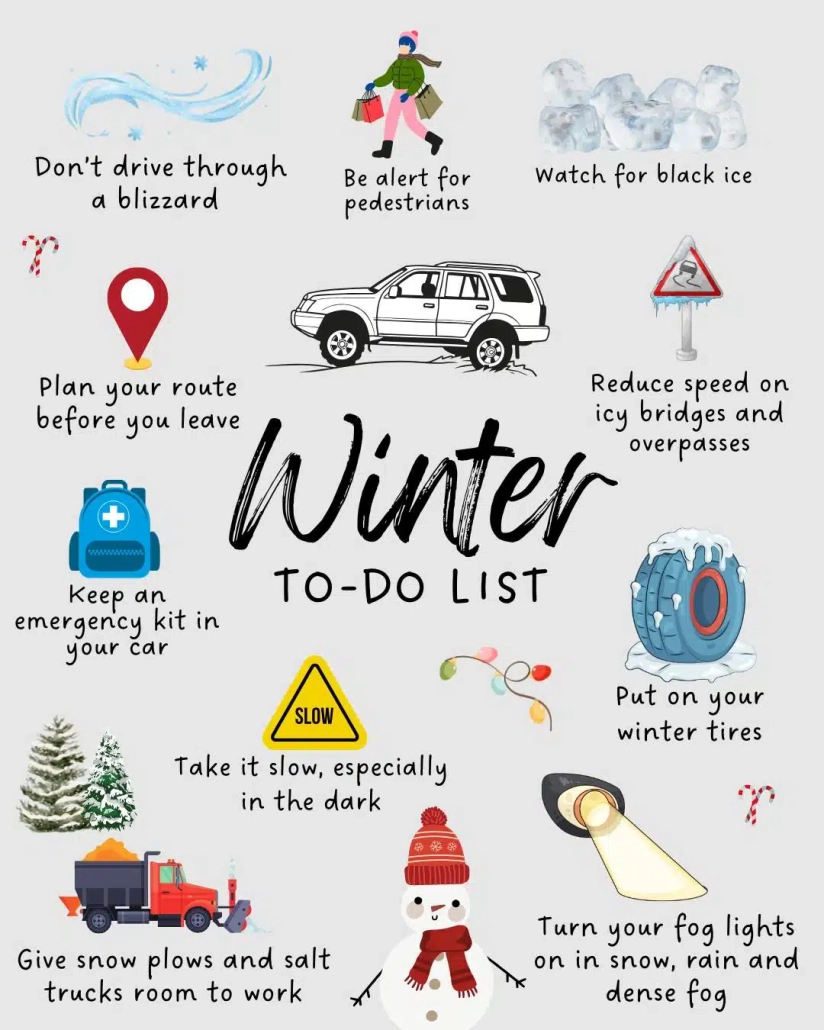
Just in case you haven’t looked outside yet, our “Three Ps” of safe winter driving tips will be extremely relevant and useful over the next couple of days.

Please be careful on the roads, and remember, if someone who isn’t driving safely runs into you or a member of your family, contact Betras, Kopp & Markota right away to arrange a free consultation to discuss your accident. Our experienced team of investigators and attorneys will evaluate your case, provide rock-solid advice, and fight to get the money your family needs and deserves.

So call the LOCAL law firm big enough to win millions from the insurance giants: BetrasKopp.

SAFETY ON WINTER ROADS

Bad roads can lead to bad wrecks. Driving on snow-covered, icy roads is tricky—even for those of us who have been doing it for decades. In order to help drivers avoid accidents, the National Highway Transportation Safety Administration and OSHA have developed the “Three Ps” of winter driving safety:

PREPARE for the trip. PROTECT yourself. PREVENT crashes on the road.

Some of the advice is pretty obvious—like making sure all the ice and snow is scraped off all your windows before you head down the road. But even though common sense dictates that being able to see is critical to safe driving, we’ve all seen people weaving around as they peer out of the very small space they’ve cleared on their windshield that looks like a porthole on a tank’s gun turret. There’s only one difference: a car isn’t a tank rolling through woods, it’s a car lurching down a road crowded with other vehicles that can be hit because the driver can’t see them, lane lines, traffic signals, or stop signs. So let’s start with the obvious, clear off all your windows, it’s a great way to prevent collisions. We’re talking to guys in particular because as the graphic shows, men are a lot more likely to drive in cars with ice-covered windows than women…

Here are the rest of NHTSA’s “Three Ps:

PREPARE

Maintain Your Car: Check battery, tire tread, and windshield wipers, keep your windows clear, put no-freeze fluid in the washer reservoir, and check your antifreeze.

Have On Hand: flashlight, jumper cables, abrasive material (sand, kitty litter, even floor mats), shovel, snow brush and ice scraper, warning devices (like flares), and blankets. For long trips, add food and water, medication, and cell phone.

Plan Your Route: Allow plenty of time (check the weather and leave early if necessary), be familiar with the maps/ directions, and let others know your route and arrival time.

Practice cold weather driving when your area gets snow — but not on a main road. Until you’ve sharpened your winter weather driving skills and know how your vehicle handles in snowy conditions, it’s best to practice in an empty parking lot in full daylight. Note our emphasis on the word “empty.”

Know what your brakes will do: stomp on antilock brakes, pump on non-antilock brakes.

Stopping distances are longer on water-covered ice and ice.

Don’t idle for a long time with the windows up or in an enclosed space.

PROTECT YOURSELF

Buckle up and use child safety seats properly.

Never place a rear-facing infant seat in front of an airbag.

Children 12 and under are much safer in the back seat.

Stopped or Stalled? Stay in your car, don’t overexert, put bright markers on antenna or windows and shine dome light, and, if you run your car, clear exhaust pipe and run it just enough to stay warm.

Don’t idle for a long time with the windows up or in an enclosed space.

PREVENT CRASHES

Drive slowly. It’s harder to control or stop your vehicle on a slick or snow-covered surface. On the road, increase your following distance enough so that you’ll have plenty of time to stop for vehicles ahead of you.

A word of caution about braking: Know what kind of brakes your vehicle has and how to use them properly. In general, if you have antilock brakes, apply firm, continuous pressure. If you don’t have antilock brakes, pump the brakes gently.

Stay calm and ease your foot off the gas while carefully steering in the direction you want the front of your vehicle to go if you find yourself in a skid. Stay off the pedals (gas and brake) until you are able to maintain control of your vehicle. This procedure, known as “steering into the skid,” will bring the back end of your car in line with the front.

Drugs and alcohol never mix with driving.

Texting while behind the wheel is especially dangerous in winter conditions. Put your phone down.

IF YOU ARE INVOLVED IN AN ACCIDENT CALL BK

Here’s one more tip: even though you do everything right, someone who does just one thing wrong in icy conditions can cause an accident in the blink of an eye. If you’re involved in a wreck caused by a careless or distracted driver contact BetrasKopp BEFORE you talk to an insurance agent or adjuster. We’ll arrange a free consultation that will give us the opportunity to evaluate your case and provide you with sound advice that will protect your rights and your ability to secure justice and the financial settlement you and your family need and deserve.

For more information, check out NHTSA’s interactive winter driving safety website by clicking here.

Police accident report clearly illustrates cause of most common motorcycle/car crashes

Unless you’ve been in an accident you’ve probably never seen an official Ohio Highway Patrol Accident Report. The members of the Betras Kopp legal team study hundreds of them every year.
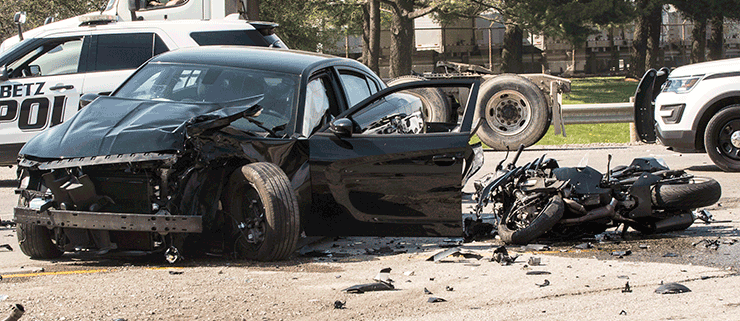
We’re sharing this OHP report about a wreck involving a motorcycle and two cars that occurred on May 10, 2025 in North Lima because it clearly illustrates what causes one of the most common types of motorcycle wrecks. The report’s narrative and drawing tells the story:

NARRATIVE

Unit 1 was traveling northbound on SR 7 in the left turn lane. Unit 2 was southbound on SR 7 in the left lane. Unit 3 was northbound on SR 7 in the left lane. Unit 1 turned west into the path of Unit 2 and was struck by Unit 2. The operator of Unit 2 was ejected onto the road into the path of Unit 3 and was struck by Unit 3

Unit 2 was a Honda motorcycle ridden by 24-year-old Josh Jetomo of Boardman. He sustained serious injuries in the crash. He was life-flighted to St. Elizabeth Hospital in Youngstown and was in critical condition.

Unit 1 was a Silverado pickup truck driven by Ralph Ridgeway. Unit 3 was a Subaru Forester operated by Sarah Guthrie.

We’ve posted safety tips for car and truck drivers on our website and social media channels in conjunction with our observance of  Motorcycle Safety Awareness Month. Today, we’re linking to a fascinating video produced by a motorcyclist who shares advice bikers can use to avoid or prevent the most common accidents in real-time as he rides. The video opens with his take on how to avoid the danger caused by drivers who make left turns in front of riders.

You can watch here: https://youtu.be/qRsCbWI5SAo?si=emOEMLcBAKHIwc6J   We urge you to take a look at the video and we’ll focus on other parts of this fascinating and important presentation as Motorcycle Safety Month rolls on.

results of car and motorcycle crash

As motorcycle season arrives in Ohio and PA, the law firm bikers trust offers tips from Motorcyclist Magazine that will help keep riders safe as they share the road with cars and trucks

Rumor has it that the temperature may actually climb above 70 degrees and stay there. That means the bikers in Ohio and Pennsylvania will soon join Floridians in enjoying the open road.

Unfortunately, that also means local bikers will face all the challenges that accompany riding in urban areas. At Betras Kopp we help riders who have been injured in accidents seek justice and just compensation.
But our real goal is to help bikers AVOID accidents. That’s why we post motorcycle safety tips on our Facebook page. This year we suggest that you review these 15 tips for safe street riding from our friends at Motorcyclist Magazine:

Watch Drivers’ Heads and Mirrors

Watching the head movements of drivers through their windows and mirrors is an excellent way to anticipate sudden moves. Most drivers won’t lunge left or right without first moving their heads one way or another—even if they don’t check their mirrors.

 Trust Your Mirrors, But Not Totally

Your bike’s mirrors can be lifesavers, but they don’t always tell the entire story even if they’re adjusted properly. In traffic, always buttress your mirror-generated rear view with a glance over the appropriate shoulder. Do it quickly and you’ll add an extra measure of rear-view and blind-spot knowledge to your info-gathering tasks.

Never Get Between A Vehicle And An Off-Ramp

This sounds almost too simple, but drivers who decide to exit at the last minute kill plenty of riders each year. The simple rule, then, is to never position yourself between a vehicle and an offramp. Passing on the right is generally a no-no, but in this day and age, it’s sometimes necessary. So if you do it, do so between exits or cross streets.

Cover Your Brakes

In traffic, you must often react extra quickly, which means not fumbling for the brake lever or pedal. To minimize reach time, always keep a finger or two on the brake lever and your right toe close to the rear brake pedal. When that cellphone-wielding driver cuts across your path trying to get to the 7-Eleven for a burrito supreme, you’ll be ready.

Be Noticed

Make sure drivers and pedestrians can see you, even from a distance. Ditch the all-black attire and wear brightly colored gear, especially your helmet and jacket. Hi-vis yellow suits and jackets are common at every gear shop.

Be Ready With The Power

In traffic, ride in a gear lower than you normally would so your bike is ready to jump forward instantly if asked. Doing so gives you the option of leaping ahead instead of being limited to just using the brakes when that pickup suddenly moves over. The higher revs might also alert more drivers to your presence.

Traffic Slowing? Stay Left—Or Right

When traffic slows suddenly, stay to the left or right of the car in front of you. This will give you an escape route if needed. It will also help keep you from becoming a car-motorcycle sandwich if the driver behind you fails to stop in time. Once you’ve stopped, be ready: clutch in, your bike in gear, and your eyes on the mirrors. You never know.

Practice The Scan

Constantly scanning your entire environment while riding—from instruments to mirrors, to the road ahead, to blind spots, to your left and right—keeps you aware and in touch with your situation, and therefore better able to react. Dwelling on one area too long—watching only behind or in front of you, for instance—is just begging for trouble.

Left-Turn Treachery

When approaching an oncoming car that’s stopped and about to turn left, be ready. Watch the car’s wheels or the driver’s hands on the steering wheel; if you see movement, be ready to brake, swerve, or accelerate, whichever seems best for the situation.

Study The Surface

Add asphalt conditions to your scan. Be on the lookout for spilled oil, antifreeze, or fuel; it’ll usually show up as shiny pavement. Also keep an eye out for gravel and/or sand, which is usually more difficult to see. Use your sense of smell too; often you can smell spilled diesel fuel before your tires discover how slippery the stuff is.

Ride In Open Zones

Use your bike’s power and maneuverability to ride in open zones in traffic. In any grouping of vehicles there are always some gaps; find these and ride in them. Doing so will separate you from four-wheelers, give you additional room to maneuver, and allow you to keep away from dangerous blind spots. And vary your speed. Riding along with the flow can make you invisible to other drivers, especially in heavy traffic.

Use That Thumb

Get into the habit of canceling your turn signals often regardless of the traffic situation. A blinking signal might tell drivers waiting to pull into the road or turning left in front of you that you’re about to turn when you aren’t. Better to wear out the switch than eat a Hummer’s hood, eh?

It’s Good To Be Thin

A huge advantage single-track vehicles have over four-wheelers is their ability to move left and right within a lane to enable the rider to see what’s ahead. Whether you’re looking to the side of the cars ahead or through their windshields, seeing what’s coming can give you lots of extra time to react.

More Than One Way Out

Yeah, motorcycles fall over. But they’re also light, narrow, and hugely maneuverable, so you might as well learn to exploit their strengths when things get ugly, right? So don’t just brake hard in a hairball situation. There’s almost always an escape route. Swerving into Mrs. Smith’s front yard could be a lot better than center-punching the Buick that turned left in front of you. Always have an escape route planned, and update it minute by minute.

Running Interference

This one’s easy, and we’ll bet most of you already do it: Let larger vehicles run interference for you when negotiating intersections. If the bonehead coming toward you from the left or right is going to blow the light, better they hit the box van next to you, right? For the same reasons, don’t lunge through an intersection as soon as the light turns green. Be patient, and use the vehicles next to you as cover.

We hope you have a safe season on the road. But if you are in an accident, contact the local law firm bikers trust: Betras Kopp Attorneys at Law.

May is Motorcycle Safety Awareness Month–Betras Kopp is here to help bikers enjoy the open road…

It’s no accident that May is Motorcycle Safety Awareness Month because as the weather gets nicer and riders hit the streets the number of wrecks involving bikes and other vehicles skyrockets.
To help keep the open road safe for bikers Betras Kopp will post tips and videos from the Motorcycle Safety Foundation (MSF), AAA, law enforcement, and the National Highway Safety Foundation during the month and throughout the summer. Check out this informative video from the MSF:  https://vimeo.com/543457795 
We’re leading off with the MSF’s Five Tips for car and truck drivers because statistics show they are at fault in 60% of the accidents involving a bike and another vehicle.
Here are the tips, please utilize them when you’re behind the wheel:
1. Take an extra moment to look for motorcycles. Because of its small size, a motorcycle can be easily hidden in a car’s blind spots, so check — then check again — before changing lanes or making a turn.
2. Predict a motorcycle is closer than it looks. A motorcycle may look farther away than it is because of its small size, and it may be difficult to judge a motorcycle’s speed. When checking traffic to turn at an intersection or into (or out of) a driveway, predict a motorcycle is closer than it appears.
3. Keep a safe distance. Motorcyclists often slow by rolling off the throttle or downshifting, thus not activating the brake light, so allow more following distance, about 3 to 4 seconds.
4. Understand lane shifting. Motorcyclists often adjust position within a lane to be seen more easily and to minimize effects of road debris, passing vehicles, and wind. Understand that motorcyclists adjust lane position for a purpose, not to show off or to allow you to share the lane with them.
5. See the person. When a motorcycle is in motion, see more than the motorcycle, see the person under the helmet, who could be your friend, neighbor, or relative.
Bikers enjoy the open road and remember, if you or someone you know is involved in a motorcycle accident, contact the local lawyers who will fight to win the settlement you need and deserve: Betras Kopp Attorneys at Law.

From exploding Pintos to out of control Teslas, trial lawyers fight to make cars safer

Attorney David BetrasOn August 10, 1978, three teenage girls, sisters Lyn and Judy Ulrich and their cousin Donna traveling to volley practice on Route 33 in Goshen, Indiana were incinerated when the gas tank in their 1973 Ford Pinto exploded after the vehicle was rear-ended by a van. Technically speaking, they were killed in an auto accident. In reality, however, they were murdered by corporate greed.

That is because Ford executives, including President Lee Iacocca, knew the Pinto was a four-wheeled death trap. Rushed into production in 1970 after only two years of development and testing, the Pinto was Ford’s response to the influx of foreign-made subcompact cars into the American market that began in the late ‘60s. During the design process company engineers sounded alarms about the gas tank which was, for a number of reasons, vulnerable to rupture in low-speed rear-end collisions. They were also concerned because a large empty space behind the backseat allowed the entire back third of the car to crumple, wedging the body and frame tightly against the car doors, making them virtually impossible to open.

Fixing the lethal combination of an exploding gas tank and jammed doors would have cost the company $15 per Pinto. Iacocca’s response: “Safety doesn’t sell.” Not surprisingly, the boss’ attitude permeated the company when attorneys representing people injured and killed in the exploding cars unearthed what became known as the “Pinto Memo.” Prepared to help Ford block new fuel system safety standards being proposed by the National Highway Transportation Safety Administration (NHTSA), the memo’s authors estimated it would cost Ford $11 per vehicle or $137 million to comply with the new regulations. They weighed that against the $50 million in litigation and settlements costs the company would incur if the cars were not made safer. Their conclusion: “the implementation costs far outweigh the expected benefits.

Picture of Tesla that rear ended a fire truck.And so the company continued to manufacture and sell the deadly vehicles for more than a decade. During that time between 500 and 900 people were burned to death. The Pinto was not pulled from the market until the cost of settling lawsuits filed on behalf of the victims and the attendant negative publicity made the car unprofitable.

I was reminded of the Pinto debacle when I read a New York Times article about a series of accidents caused by Tesla’s autopilot system. The story focused on the death of 22-year-old Naibel Benavides who was killed when a Model S in autopilot mode traveling 66 MPH on a city street ran a stop sign and slammed into the parked Chevy Tahoe in which she was sitting. The car’s brakes were never applied.

While a Tesla is as different from a Pinto as the Wright Brothers’ plane is from an F-16, the cause of the crashes that killed the Ulrich’s and Ms. Benavides are the same: placing pursuit of profit ahead of people. Unlike Ford, GM, and other carmakers who use technology to restrict their systems to divided highways where there are no stop signs, traffic lights or pedestrians, Tesla allows drivers to use autopilot anywhere and everywhere. The results are predictable and tragic: the number of accidents involving Tesla’s system is skyrocketing.

And I suspect that lawsuits filed by victims are the only thing that will stop the carnage.

Every time I think of the victims we represent or read reports about companies who place no value on human life, I am reminded of why I went to law school, why I go to work every day, and why we should all fight to preserve the civil justice system that makes our world a safer place to live.

It’s that time of year–time for winter driving tips from Betras, Kopp & Markota

Winter driving tipsJust in case you haven’t looked outside yet, our “Three Ps” of safe winter driving tips will be extremely relevant and useful over the next couple of days.

Please be careful on the roads, and remember, if someone who isn’t driving safely runs into you or a member of your family, contact Betras, Kopp & Markota right away to arrange a free consultation to discuss your accident. Our experienced team of investigators and attorneys will evaluate your case, provide rock-solid advice, and fight to get the money your family needs and deserves.

So call the LOCAL law firm big enough to win millions from the insurance giants: Betras, Kopp & Markota.

SAFETY ON WINTER ROADS

Bad roads can lead to bad wrecks. Driving on snow-covered, icy roads is tricky—even for those of us who have been doing it for decades. In order to help drivers avoid accidents, the National Highway Transportation Safety Administration and OSHA have developed the “Three Ps” of winter driving safety:

PREPARE for the trip. PROTECT yourself. PREVENT crashes on the road.

Some of the advice is pretty obvious—like making sure all the ice and snow is scraped off all your windows before you head down the road. But even though common sense dictates that being able to see is critical to safe driving, we’ve all seen people weaving around as they peer out of the very small space they’ve cleared on their windshield that looks like a porthole on a tank’s gun turret. There’s only one difference: a car isn’t a tank rolling through woods, it’s a car lurching down a road crowded with other vehicles that can be hit because the driver can’t see them, lane lines, traffic signals, or stop signs. So let’s start with the obvious, clear off all your windows, it’s a great way to prevent collisions. We’re talking to guys in particular because as the graphic shows, men are a lot more likely to drive in cars with ice-covered windows than women…

Here are the rest of NHTSA’s “Three Ps:

PREPARE

Maintain Your Car: Check battery, tire tread, and windshield wipers, keep your windows clear, put no-freeze fluid in the washer reservoir, and check your antifreeze.

Have On Hand: flashlight, jumper cables, abrasive material (sand, kitty litter, even floor mats), shovel, snow brush and ice scraper, warning devices (like flares), and blankets. For long trips, add food and water, medication, and cell phone.

Plan Your Route: Allow plenty of time (check the weather and leave early if necessary), be familiar with the maps/ directions, and let others know your route and arrival time.

Practice cold weather driving when your area gets snow — but not on a main road. Until you’ve sharpened your winter weather driving skills and know how your vehicle handles in snowy conditions, it’s best to practice in an empty parking lot in full daylight. Note our emphasis on the word “empty.”

Know what your brakes will do: stomp on antilock brakes, pump on non-antilock brakes.

Stopping distances are longer on water-covered ice and ice.

Don’t idle for a long time with the windows up or in an enclosed space.

PROTECT YOURSELF

Buckle up and use child safety seats properly.

Never place a rear-facing infant seat in front of an airbag.

Children 12 and under are much safer in the back seat.

Stopped or Stalled? Stay in your car, don’t overexert, put bright markers on antenna or windows and shine dome light, and, if you run your car, clear exhaust pipe and run it just enough to stay warm.

Don’t idle for a long time with the windows up or in an enclosed space.

PREVENT CRASHES

Drive slowly. It’s harder to control or stop your vehicle on a slick or snow-covered surface. On the road, increase your following distance enough so that you’ll have plenty of time to stop for vehicles ahead of you.

A word of caution about braking: Know what kind of brakes your vehicle has and how to use them properly. In general, if you have antilock brakes, apply firm, continuous pressure. If you don’t have antilock brakes, pump the brakes gently.

Stay calm and ease your foot off the gas while carefully steering in the direction you want the front of your vehicle to go if you find yourself in a skid. Stay off the pedals (gas and brake) until you are able to maintain control of your vehicle. This procedure, known as “steering into the skid,” will bring the back end of your car in line with the front.

Drugs and alcohol never mix with driving.

Texting while behind the wheel is especially dangerous in winter conditions. Put your phone down.

You can check out NHTSA’s interactive winter driving safety website by clicking here.

IF YOU ARE INVOLVED IN AN ACCIDENT CALL BKH

Here’s one more tip: even though you do everything right, someone who does just one thing wrong in icy conditions can cause an accident in the blink of an eye. If you’re involved in a wreck caused by a careless or distracted driver contact Betras, Kopp & Markota BEFORE you talk to an insurance agent or adjuster. We’ll arrange a free consultation that will give us the opportunity to evaluate your case and provide you with sound advice that will protect your rights and your ability to secure justice and the financial settlement you and your family need and deserve.