
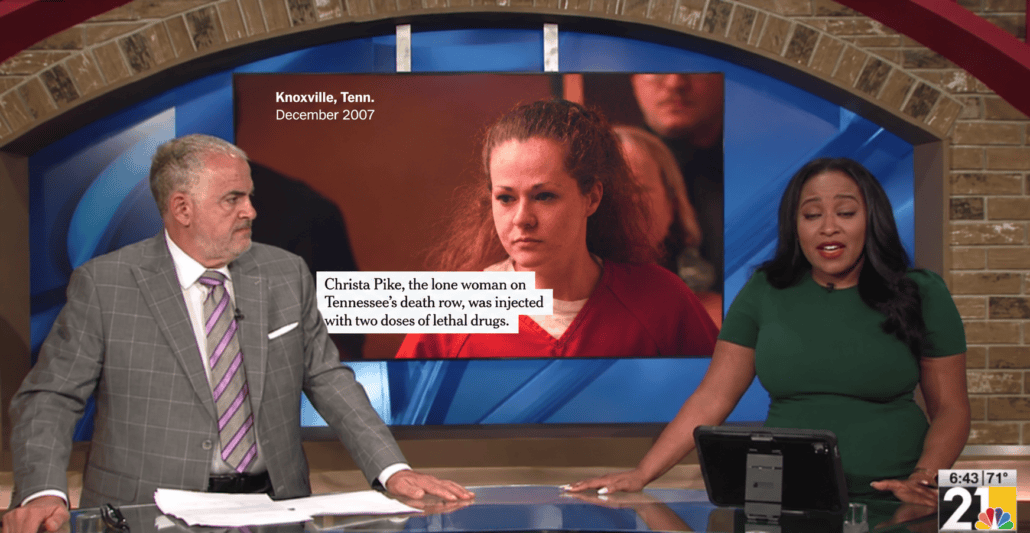
Betars: Botched execution of Krista Pike raises Constitutional issues

Managing Shareholder David Betras
In this episode of Legally Speaking on WFMJ Today, BK Managing Shareholder discusses the failed execution of Krista Pike in Tennessee. Pike, who did not die after receiving two doses of phenobarbital, was rushed to a local hospital where she remains unconscious and on a ventilator. Her prognosis is unknown. Tennessee governor Bill Lee has canceled all scheduled executions while the state determines what went wrong. She was sentenced to death in 1996 for the brutal torture and killing of her 19-year-old classmate, Colleen Slemmer.
“I want to tell people out there that I understand their reaction,” Atty. Betras said. “This woman horrifically… tortured and murdered her victim. So, a lot of people are saying ,huh, what difference does it make?” “Now, Tennessee gave her five grams of phenobarbital twice and that didn’t kill her, “ he continued. “She had to go to the hospital. The governor of Tennessee has put a moratorium on that, okay, and said, we’re going to stop executions until we figure out what’s going on.” “That gives her lawyers a foothold. I know a lot of people are out there saying, hey ,Dave, she killed and tortured her victim, why should we show any mercy?” Betras said.
|” Because the Bill of Rights which was ratified by the states in 1789 includes the Eighth Amendment that prohibits cruel and unusual punishment,” he explained. “The Supreme Court has clearly said we can execute people and they also said the process does not have to be painless,” Betras noted. “But when that amendment was adopted people were being burned at the stake, disemboweled, and drawn and quartered. So clearly there is a difference between executing someone and torturing them. That’s what the Eighth Amendment’s was designed to stop.”
“I know people are out there going, oh, and if you read the facts of what she did to this woman, it was horrific,” Betars said. “Yeah, it was terrible. But you can’t just like certain amendments and hate others.” “For example, you don’t like what someone’s saying and it makes you angry? The First Amendment protects their right to say it.” “You don’t like guns? The Second Amendment gives people the right to keep and bear arms.” “You don’t like the Fourth Amendment because you want police to just be able to invade someone’s home juct because they think they may have committed a crime? Too bad, the cops just can’t do that,” Betras said.
“Ultimately this case isn’t about whether she should be put to death, it’s about what restraints we’re going to place on the government.” “So, her attorneys now have a new set of arguments to use to try to convince a court to spare her the death penalty,” he said. “It doesn’t mean she can’t be executed and it doesn’t mean she’s getting out of jail. But there is a difference between torture and killing someone,” Betras continued. “And what people out there must understand is that they have an emotional gut reaction. But what the Constitution is trying to do is limit government’s power.
“As a civilized society we should not, when carrying out the death penalty, draw it out ten hours or tie people to posts and put stuff all over them that will attract rats who will eat them alive,” Betras said. “We are beyond that as a society.”



