
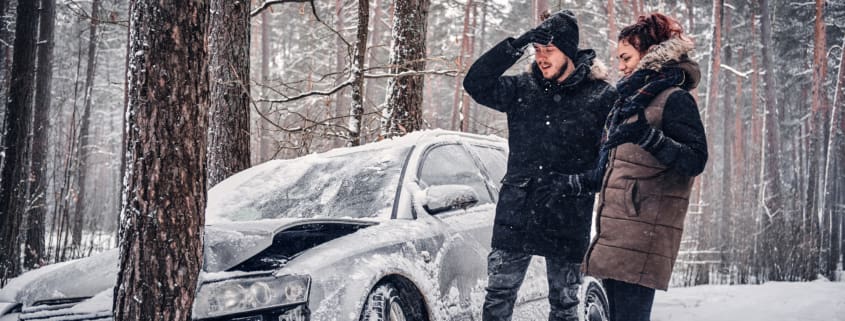
The weather outside is frightful so now is the time to check out BKM’s winter driving tips…
Just in case you haven’t looked outside yet, our “Three Ps” of safe winter driving tips will be extremely relevant and useful over the next couple of days.
Please be careful on the roads, and remember, if someone who isn’t driving safely runs into you or a member of your family, contact Betras, Kopp & Markota right away to arrange a free consultation to discuss your accident. Our experienced team of investigators and attorneys will evaluate your case, provide rock-solid advice, and fight to get the money your family needs and deserves.
So, call the LOCAL law firm big enough to win millions from the insurance giants: Betras, Kopp & Markota.
SAFETY ON WINTER ROADS
Bad roads can lead to bad wrecks. Driving on snow-covered, icy roads is tricky—even for those of us who have been doing it for decades. In order to help drivers avoid accidents, the National Highway Transportation Safety Administration and OSHA have developed the “Three Ps” of winter driving safety:
PREPARE for the trip; PROTECT yourself; and PREVENT crashes on the road.
Some of the advice is pretty obvious—like making sure all the ice and snow is scraped off all your windows before you head down the road. But even though common sense dictates that being able to see is critical to safe driving, we’ve all seen people weaving around as they peer out of the very small space they’ve cleared on their windshield that looks like a porthole on a tank’s gun turret. There’s only one difference: a car isn’t a tank rolling through woods, it’s a car lurching down a road crowded with other vehicles that can be hit because the driver can’t see them, lane lines, traffic signals or stop signs. So let’s start with the obvious, clear off all your windows, it’s great way to prevent collisions. We’re talking to guys in particular, because as the graphic shows, men are a lot more likely to drive in cars with ice-covered windows then women…
Here’s rest of NHTSA’s “Three Ps:
PREPARE
Maintain Your Car: Check battery, tire tread, and windshield wipers, keep your windows clear, put no-freeze fluid in the washer reservoir, and check your antifreeze.
Have On Hand: flashlight, jumper cables, abrasive material (sand, kitty litter, even floor mats), shovel, snow brush and ice scraper, warning devices (like flares) and blankets. For long trips, add food and water, medication and cell phone.
Plan Your route: Allow plenty of time (check the weather and leave early if necessary), be familiar with the maps/ directions, and let others know your route and arrival time.
Practice cold weather driving when your area gets snow — but not on a main road. Until you’ve sharpened your winter weather driving skills and know how your vehicle handles in snowy conditions, it’s best to practice in an empty parking lot in full daylight. Note our emphasis on the word “empty.”
Know what your brakes will do: stomp on antilock brakes, pump on non-antilock brakes.
Stopping distances are longer on water-covered ice and ice.
Don’t idle for a long time with the windows up or in an enclosed space.
PROTECT YOURSELF
Buckle up and use child safety seats properly.
Never place a rear-facing infant seat in front of an air bag.
Children 12 and under are much safer in the back seat.
Stopped or Stalled? Stay in your car, don’t overexert, put bright markers on antenna or windows and shine dome light, and, if you run your car, clear exhaust pipe and run it just enough to stay warm.
Don’t idle for a long time with the windows up or in an enclosed space.
PREVENT CRASHES
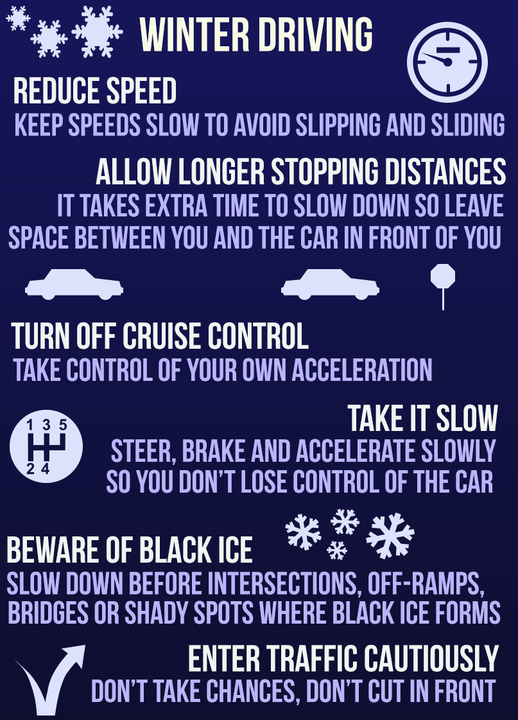
Drive slowly. It’s harder to control or stop your vehicle on a slick or snow-covered surface. On the road, increase your following distance enough so that you’ll have plenty of time to stop for vehicles ahead of you.
A word of caution about braking: Know what kind of brakes your vehicle has and how to use them properly. In general, if you have antilock brakes, apply firm, continuous pressure. If you don’t have antilock brakes, pump the brakes gently.
Stay calm and ease your foot off the gas while carefully steering in the direction you want the front of your vehicle to go if you find yourself in a skid. Stay off the pedals (gas and brake) until you are able to maintain control of your vehicle. This procedure, known as “steering into the skid,” will bring the back end of your car in line with the front.
Drugs and alcohol never mix with driving.
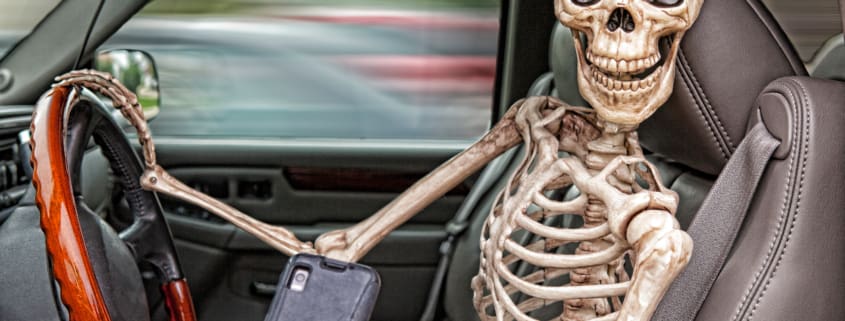
Texting while behind the wheel is especially dangerous in winter conditions. Put your phone down.
You can check out NHTSA’s interactive winter driving safety website by clicking here.
Here’s one more tip: even though you do everything right, someone who does just one thing wrong in icy conditions can cause an accident in the blink of an eye. If you’re involved in a wreck caused by a careless or distracted driver, contact Betras, Kopp & Markota BEFORE you talk to an insurance agent or adjuster. We’ll arrange a free consultation that will give us the opportunity to evaluate your case and provide you with sound advice that will protect your rights and your ability to secure justice and the financial settlement you and your family needs and deserves.

 On August 10, 1978, three teenage girls, sisters Lyn and Judy Ulrich and their cousin Donna traveling to volley practice on Route 33 in Goshen, Indiana were incinerated when the gas tank in their 1973 Ford Pinto exploded after the vehicle was rear-ended by a van. Technically speaking, they were killed in an auto accident. In reality, however, they were murdered by corporate greed.
 And so the company continued to manufacture and sell the deadly vehicles for more than a decade. During that time between 500 and 900 people were burned to death. The Pinto was not pulled from the market until the cost of settling lawsuits filed on behalf of the victims and the attendant negative publicity made the car unprofitable.
 For starters, according to the Supreme Court’s 1966 ruling in Miranda v. Arizona, law enforcement officers do not have to issue a Miranda warning unless they are conducting a custodial interrogation. In plain English, that means suspects do not have to be advised of their right to keep their yap shut unless and until they have been deprived of their freedom of action in a significant way.
 Frivolous, adjective: not having any serious purpose or value.
 About the exceptions, I mentioned earlier. They exist, but they are incredibly difficult to secure. Under Title VII of the Civil Rights Act of 1964 employers must make “reasonable accommodations” for workers who object to being immunized due to their “sincerely held” religious beliefs. Here’s a tip: personal or ethical objections like those harbored by members of the “anti-vax” movement generally won’t qualify as a religious belief.


