
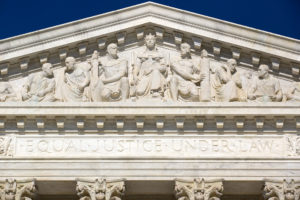
Supreme Court will decide unprecedented number of blockbuster cases during 2021-2022 term
 Like kids counting the days until Christmas, attorneys, legal scholars, and jurisprudence junkies, including me, eagerly anticipate the first Monday in October, the day the Supreme Court of the United States (SCOTUS) begins its new term each year. We can barely control ourselves as we wait for the justices to decide which of the 7,000 cases submitted to them annually become one of the 150 or so they hear.
Under normal circumstances, the justices go about their work in relative obscurity because the cases on the Court’s docket, which is dominated by battles between states over water rights, business disputes, and arguments about arcane legal principles, do not impact the lives of most Americans or generate much media coverage aside from long, jargon-packed pieces posted on SCOTUSblog. Believe me, if you have insomnia, spend a few minutes on the site and you will be sleeping in no time.
This year, however, is far from normal. Although the 2021-2022 term is less than two weeks old, the Court is under intense scrutiny because the justices have agreed to hear a number of cases that may ignite legal and societal firestorms while further undermining the public’s waning support for the Court which was once widely regarded, in the words of Alexander Hamilton, as the “least dangerous” branch of government.
 Chief among the potential blockbusters is Dobbs v. Jackson Women’s Health Organization, which centers on a Mississippi law which, with few exceptions, prohibits abortions after 15 weeks of gestation. Dobbs gives the Court the opportunity to overturn Roe v. Wade which established a woman’s right to choose and Planned Parenthood v. Casey, which protects that right until viability. It is, quite simply, the most important reproductive rights case to come before the Court in 30 years.
New York State Rifle & Pistol Association Inc. v. Bruen is the first significant firearms case to come before the Court since the 2008 ruling in District of Columbia v. Heller that extended Second Amendment protections to individuals. Bruen arrives at the Court on appeal from the 2nd Circuit which upheld New York state’s strict gun licensure law which requires residents to obtain a permit to possess a firearm and totally bans open carry. A decision in favor of the Association could gut gun laws across the nation.
Like Bruen, Carson v. Makin which challenges Maine’s prohibition against using state funds to pay tuition for schools that offer religious instruction has nationwide implications. The justices will decide if Maine’s law violates the free exercise, establishment, and equal protection clauses of the Constitution. If they so hold, voucher programs across the U.S., including Ohio’s will be impacted and taxpayer dollars will begin flowing to schools that promote religion.
Other important cases include Students for Fair Admissions v. President and Fellows of Harvard College which poses a lethal threat to race-based college admission programs, CVS Pharmacy Inc. v. Doe which involves alleged discrimination against persons with HIV, as well as cases focused on national security, campaign finance laws, and Texas’ new draconian abortion restrictions.
The last time the Court ruled on this many consequential cases in one term was, well, never. Throughout history, cases of similar magnitude to the ones on SCOTUS’ 2021-2022 docket were heard and decided every five or ten years. As a result, one thing is certain: the justices will not labor in obscurity over the next 12 months.
 Along with defining prosecutors’ role, the rules, laws, and Supreme Court decisions also set forth their responsibilities, which, according to the ABA’s CJS include the duty to “…make timely disclosure to the defense of all evidence or information known to the prosecutor that tends to negate the guilt of the accused or mitigates the offense…”


