BetrasKopp files lawsuit seeking injunction that will enable student athletes trapped in scandal-plagued Ursuline High School football program to transfer to other schools

After Ursuline High School cancelled the 2025 football season in the midst of allegations that some players had engaged in hazing, sexual misconduct, physical abuse, and harassment during an out of state team trip, a number of student athletes who were not involved in the incidents explored the possibility of transferring to and playing for other schools this year. On September 16, 2025, the Ohio High School Athletic Association (OHSAA), the body that governs interscholastic athletics in the state, ruled they could not.

In a lawsuit filed on behalf of six of the players on September 22, 2025, Attorneys Brian Kopp and Frank Cassese of BetrasKopp LLC asked the Mahoning County Common Pleas Court to issue a Temporary Restraining Order as well as temporary and permanent injunctions that will prevent the OHSAA, its Executive Director DougUte, and/or his agents from enforcing that ruling.

“These student athletes have done nothing wrong,” Attorney Kopp said. “Through no fault of their own they’ve been robbed of the opportunity to play for Ursuline, and, in the case of seniors, to ever play high school football again. If a parent believes it is best to transfer their child out of Ursuline High School so they can continue their athletic careers they should have the right to do so. This lawsuit was filed to guarantee that right will not be restricted by the OHSAA’s arbitrary and unjust decisions.”

“The OHSAA is sending a troubling message to high school student-athletes and parents across Ohio: ‘Blow the whistle and get benched,’” Attorney Cassese commented. “Student athletes who observe the type of behavior that allegedly occurred at Ursuline are going to think twice about reporting it if the OHSAA insists on punishing the innocent right along with the guilty. Mr. Ute and his staff should have done their due diligence and allowed those who were not involved in the incident to transfer to another school and move on with their lives. Instead, the clear directive moving forward is remain silent or risk losing everything.”

In the lawsuit the plaintiffs assert that the rules and by-laws the OHSAA cited in denying students the right to transfer are neither pertinent nor applicable to Ursuline’s situation.  because they are intended to “prevent student athletes from ‘shopping around’ for a school to attend based solely on which school will best showcase the student’s athletic talents, which, in turn, would promote an atmosphere of athletic recruiting at the high school level.”

“Our clients aren’t ‘shopping around’ for a better school because they want to, they’re seeking permission to transfer because the Diocese of Youngstown and Ursuline’s administration failed to deal with allegations of misconduct in early June,” Attorney Kopp said. “Now, as a result of the OHSAA’s ruling, these students are trapped in an institution plagued by civil and criminal action and a football program shrouded in uncertainty. Fortunately, the Court has the power to set them free by issuing the TRO and injunctions we are seeking.”

In the suit the plaintiffs note they will suffer irreparable harm if injunctive relief is not granted:

Plaintiffs do not have monetary damages. They are being prevented from participating in interscholastic athletics because of the actions of other individuals. The fleeting nature of high school sports means that Plaintiffs can never recoup the missed contests that are played while this unjustified penalty from the OHSAA remains enforced. Plaintiffs have and will continue to suffer irreparable harm through the OHSAA’s decisions, for which there is no adequate remedy at law. A temporary restraining order and preliminary and permanent injunction enjoying Defendants from enforcing the OHSAA’s decision is the only available remedy.

For more information please contact Frank Cassese at 330-746-8484.  The Verified Complaint may be viewed and downloaded here.  The Motion for TRO  may be viewed and downloaded here.


Attorney David Betras

Attorney David Betras receives Martindale-Hubbell 40-year Practice Recognition Award in honor of his four decades serving clients in Ohio, Pennsylvania, and Florida

In 2025 Attorney Betras received the Martindale-Hubbell 40-year Practice Recognition Award which honors his four decades of service to clients in Ohio, Pennsylvania, and Florida.

 

What you need to know about Ohio’s new consumer fireworks law–aside from the fact that it actually makes sense…

If there is one thing I’ve learned during my three decades as an attorney, it’s that laws don’t always make sense. As an example, I offer into evidence, the Ohio statute that governed the purchase and use of consumer-grade fireworks by private citizens from 2008 until 2022. During that time, you or I could walk into a licensed fireworks dealer on July 4, buy a carload of what are known as 1.4G fireworks, and then swear we were going to transport our arsenal out of state within 48 hours because it was illegal to discharge them within the state.

Attorney David Betras
BKM Managing Partner David Betras

This law was ridiculous for two reasons: first, it forced Ohioans who wanted to celebrate Independence Day by firing off some fireworks in their backyard to lie and commit a crime which was more than a little ironic and absolutely un-American, and, second, it was, for all intents and purposes, unenforceable, a fact underscored by the billions of dollars in consumer pyrotechnics that lit up Ohio’s night skies and scared Ohio’s dogs each and every Fourth—prohibition or no prohibition.

After numerous attempts to erase the law and government-mandated ruse from the books, the fine folks who inhabit the Ohio House and Senate passed HB 172 by overwhelming margins on November 4, 2021. One provision of the bill which became effective on July 1, 2022 eliminated the requirement that Ohioans hightail it out of the state to demonstrate their patriotism. As a result, we are now free to shoot off roman candles, skyrockets, sparking wheels, seven-shot Beastlys, and 10-ten shot Cherry Bombers from the comfort of our homes.

In addition to permitting the use of consumer fireworks within Ohio’s borders, HB 172 also established regulations for doing so—you know rules we didn’t need when we were buying 36-shot China Dragons here and shooting them off in, I guess Pennsylvania or West Virginia. Because the law is relatively new, and the Fourth of July is rapidly approaching I thought it would be beneficial to review the rules:

Let’s start with when we can fire away:

From 4 PM to 11 PM on:

  • From 4 PM to 11 PM on July 3, 4, and 5, and the Friday, Saturday and Sunday immediately before and after the 4th.
  • From 4 PM to 11 PM on Memorial and Labor Day weekends
  • From 4 PM to 11:59 PM on New Year’s Eve and 12 AM to 1:00 AM and 4 PM to 11 PM New Year’s Day
  • From 4 PM to 11 PM on Chinese New Year
  • From 4 PM to 11 PM on Cinco de Mayo
  • From 4 PM to 11 PM on Diwali, the Hindu Festival of Lights which falls on November 12 this year.
  • From 4 PM to 11 PM on Juneteenth.

Next let’s talk about where.  You can light up the night from your own property or another person’s if the owner has given you express permission. Oh, and you can’t fire them off indoors, so no shooting Roman Candles at your siblings or friends if you’re in the kitchen or living room. You also may not discharge fireworks within 150 feet of property housing livestock unless the owner of the property is given five days’ notice. I guess that will give the livestock owner time to sedate the animals. 

Who is important. No one under the age of 18 and no person under the influence of any intoxicating liquor, beer, or controlled substance may discharge fireworks.

Finally, let’s not forget that fireworks can be dangerous if they are mishandled or used carelessly. According to a report issued by the Consumer Product Safety Commission 11,500 fireworks-related injuries were treated in U.S. hospitals in 2021. Not surprisingly, the vast majority of the injuries occurred between June 18 and July 18. To make sure your holiday isn’t marred by an accident, please follow these safety tips as you celebrate America’s 257th birthday:

  • Never allow young children to handle fireworks.
  • Anyone using fireworks or standing nearby should wear protective eyewear.
  • Never hold lit fireworks in your hands.
  • Only use fireworks away from people, houses, and flammable material.
  • Do not try to re-light or handle malfunctioning fireworks.
  • Soak both spent and unused fireworks in water for a few hours before discarding.
  • Keep water or a fire extinguisher nearby to fully douse fireworks that don’t discharge or in case of fire.

Thanks for taking the time to check out this week’s blog and Happy Fourth to you all.

Betras Kopp offers life-saving tips that will help keep kids safe around pools and spas

For most kids, summer is the best season of the year—especially if they have access to a swimming pool. But along with swimming, diving, splashing, and fun comes danger: drowning is the leading cause of accidental death among children aged one to four and claimed nearly 400 young lives last year and sent another 6,500 kids to the emergency room.
Because the Betras Kopp team is dedicated to helping keep you, your kids and other family members safe, we’re providing these tips from Poolsafely.gov  that will go a long way toward ensuring your child doesn’t become a tragic statistic:

1. Never leave a child unattended in or near water.

Always watch children when they’re in or near water, and never leave them unattended. Designate an official Water Watcher, an adult tasked with supervising children in the water. That should be their only task – they shouldn’t be reading, texting or playing games on their phone. Have a phone close by at all times in case you need to call for help, and if a child is missing, check the pool first.
Even if a lifeguard is present, parents and caregivers should still take the responsibility of being a designated Water Watcher. When any lifeguard chair is empty, the remaining lifeguards may not be able to see the entire pool and when lifeguards are seated in low chairs, their view can be blocked by patrons in the pool.

2. Teach children how to swim.

Swimming is not only fun, it’s a lifesaving skill. Enroll children in swimming lessons; there are many free or reduced-cost options available from your local YMCA, USA Swimming chapter or Parks and Recreation Department.

3. Teach children to stay away from drains.

Do not play or swim near drains or suction outlets, especially in spas and shallow pools, and never enter a pool or spa that has a loose, broken or missing drain cover. Children’s hair, limbs, jewelry or bathing suits can get stuck in a drain or suction opening. When using a spa, be sure to locate the emergency vacuum shutoff before getting in the water.

4. Ensure all pools and spas – both in your backyard and any public pool you may visit – have compliant drain covers.

Virginia Graeme Baker, after whom the Pool and Spa Safety Act is named, died from drowning due to a suction entrapment from a faulty drain cover. All public pools and spas must have drain grates or covers that meet safety standards to avoid incidents like the one that took Graeme’s life. Powerful suction from a pool or spa drain can even trap an adult.

5. Install proper barriers, covers and alarms on and around your pool and spa.

Proper fences, barriers, alarms and covers can be lifesaving devices. A fence of at least four feet in height should surround the pool or spa on all sides and should not be climbable for children. The water should only be accessible through a self-closing, self-latching gate. Teach children to never try to climb over the gate or fence. Install a door alarm from the house to the pool area, and keep pool and spa covers in working order.

6. Know how to perform CPR on children and adults.

Often, bystanders are the first to aid a drowning victim, so learning CPR can help save a life. And once you’re CPR certified, make sure to keep your certification current. CPR classes are available through many hospitals, community centers, or by contacting the American Red Cross.

7. Take the Pledge!

Before heading to the pool or spa with your family, remember to take the Pool Safely Pledge. This online call to action is a reminder to stay safer around the water.

Thanks for taking a few minutes to learn more about pool safety and please share it with your family members and friends. We also invite you to check our website and social media platforms for additional information that will keep you and your family safe this summer.

Ohio General Assembly considers new legislation dealing with dangerous dogs irresponsible owners

Avery Russell, 11, of Columbus is rebuilding her life after a traumatic attack by two pit bulls on June 11, 2024. Surgeons at Nationwide Children’s Hospital performed a nine hour emergency surgery just after the attack. Photo by Barbara J. Perenis of the Columbus Dispatch.

As we noted when we reprinted the USA Today Ohio News Network series “VICIOUS: An investigation into how Ohio laws fail thousands of dog attack victims,” the laws related to dog bites and attacks and are woefully inadequate and put us all at risk of suffering the types of debilitating, disfiguring injuries sustained by 11-year-old Avery Russel who was attacked by two pit bulls.  During the attack the dogs chewed off most of Avery’s ears, ripped into her nose, left a huge gouge above her left eye and punctured her forehead and shoulder. Her face, one doctor said, looked like ground hamburger.

Despite all the damage, the dogs’ owners face only misdemeanor charges.

Fortunately, some member of the Ohio General Assembly are taking action. According to the following report from the Gongwer Statehouse News Service, three bills designed to strengthen Ohio’s dog attack laws have just been introduced in the Ohio House. One, HB 240 which is sponsored by Rep. Meredith Lawson-Rowe (D-Reynoldsburg), is named “Avery’s Law.”  In addition to the three bills already in the hopper, State Rep. Phil Plummer of Dayton plans to introduce a fourth in the near future.

We’ll provide updates as the legislation makes its way through the Gneral Assembly and, when the time comes, we’ll ask our readers to contact our state reps and senators and urge them to support the bills. We want to commend the sponsors of the legislation for taking positive steps to protect our families–especially our children–and hold irresponsible owners accountable for their actions. Here’s the Gongwer report:

Dangerous dogs were a topic of discussion for a House panel Tuesday.

The House Public Safety Committee  fielded testimony on three bills addressing the issue.

One measure redefines what constitutes a nuisance, dangerous and vicious dog (HB 247 ).

Sponsoring Rep. Kevin Miller (R-Newark) said the need for the bill was brought to his attention by the dog warden of Licking County.

He explained that the changes in law in his bill pertain only to unprovoked attacks.

“Dogs that act in defense of themselves, their owners, or their property are explicitly protected under this bill. The intent is not to punish responsible owners or protective dogs,” he said. “Conversely this legislation aims to address cases of negligence where irresponsible owners of dangerous and vicious dogs fail to keep their animals from harming the public.”

Miller told the panel the bill provides the local dog warden the power to seize a dog immediately following an attack in which a victim is killed or seriously injured.

He said it will also hold irresponsible dog owners accountable when they fail to control dogs already designated as dangerous or vicious.

“Penalties for these individuals have been increased to better reflect the seriousness of their negligence,” he said. “Basically, these individuals have previously been put on notice they possess an extremely malicious animal but continue to fail to ensure the safety of the public. This is simply not acceptable. In the most severe cases of a serious injury or death, the penalty will raise from a felony of the fourth to a third-degree felony.”

After Rep. Haraz Ghanbari (R-Perrysburg) revealed that he was attacked by two German Shepherds last year while campaigning, Rep. Juantia Brent (D-Cleveland) questioned whether the bill would cover his situation since he was on someone else’s property.

Miller said it would require a probable cause hearing to determine whether the attack was unprovoked.

The other bills are sponsored by Rep. Cecil Thomas (D-Cincinnati) and Rep. Meredith Lawson-Rowe (D-Reynoldsburg).

One (HB 240 ) was inspired by a 2024 dog attack in Reynoldsburg that left a 12-year-old severely injured.

Lawson-Rowe told the panel the two pit bulls had attacked before, but their owner failed to report the previous incident.

Among the changes in the bill, it would require an owner to report an attack within 24 hours.

“Cities across the state have created ordinances regulating dogs and increasing penalties for owners of dogs who attack or even kill humans and other animals. It’s time that we as a state do the same,” she said. “Again, it is our hope that we can use House Bill 240, Avery’s Law, to strengthen our dog laws statewide and to give families who go through these tragic incidents, adequate legal recourse.”

Thomas said the bill will help to ensure that repeat-offender dogs and negligent owners can no longer slip through the legal cracks.

“Importantly, this legislation does not target any one breed. It targets behavior – and the responsibility of those who own dogs,” he said. “Responsible dog owners who properly train, contain, and care for their pets will have nothing to fear under this bill. But those who neglect or conceal their dog’s violent history must be held to account – because the cost of doing nothing is simply too high.”

Their other piece of legislation requires a dog to be held for a 10-day quarantine period following an attack in which the dog injures, seriously injures or kills a person and mandates a court hearing to determine the animal’s disposition (HB 241 ).

Thomas said that after a recent dog attack in his district, the animal was allowed to remain in its home under current state law.

“Ten days later, nothing had changed,” he said. “The owners were under no legal obligation to surrender the dogs. The victims, meanwhile, were left to live in fear.”

Lawson-Rowe echoed that sentiment.

“Victims and families of victims should not have to worry about a dog who has attacked already being left at home to possibly attack again,” she said. “This bill would close this loophole and would create due process for all parties involved.”

Rep. Thomas Hall (R-Middletown) asked why there are three separate bills addressing the same issue.

“We are all attempting to accomplish the same effort here,” Thomas responded.

Rep. Phil Plummer (R-Dayton) noted he is working on a fourth, more expansive bill that would touch on other areas of animal care.

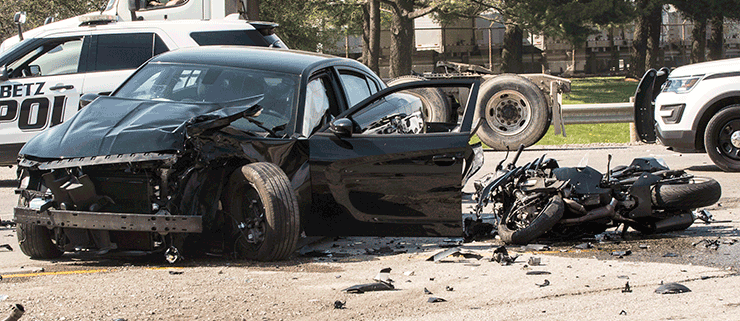
results of car and motorcycle crash

As motorcycle season arrives in Ohio and PA, the law firm bikers trust offers tips from Motorcyclist Magazine that will help keep riders safe as they share the road with cars and trucks

Rumor has it that the temperature may actually climb above 70 degrees and stay there. That means the bikers in Ohio and Pennsylvania will soon join Floridians in enjoying the open road.

Unfortunately, that also means local bikers will face all the challenges that accompany riding in urban areas. At Betras Kopp we help riders who have been injured in accidents seek justice and just compensation.
But our real goal is to help bikers AVOID accidents. That’s why we post motorcycle safety tips on our Facebook page. This year we suggest that you review these 15 tips for safe street riding from our friends at Motorcyclist Magazine:

Watch Drivers’ Heads and Mirrors

Watching the head movements of drivers through their windows and mirrors is an excellent way to anticipate sudden moves. Most drivers won’t lunge left or right without first moving their heads one way or another—even if they don’t check their mirrors.

 Trust Your Mirrors, But Not Totally

Your bike’s mirrors can be lifesavers, but they don’t always tell the entire story even if they’re adjusted properly. In traffic, always buttress your mirror-generated rear view with a glance over the appropriate shoulder. Do it quickly and you’ll add an extra measure of rear-view and blind-spot knowledge to your info-gathering tasks.

Never Get Between A Vehicle And An Off-Ramp

This sounds almost too simple, but drivers who decide to exit at the last minute kill plenty of riders each year. The simple rule, then, is to never position yourself between a vehicle and an offramp. Passing on the right is generally a no-no, but in this day and age, it’s sometimes necessary. So if you do it, do so between exits or cross streets.

Cover Your Brakes

In traffic, you must often react extra quickly, which means not fumbling for the brake lever or pedal. To minimize reach time, always keep a finger or two on the brake lever and your right toe close to the rear brake pedal. When that cellphone-wielding driver cuts across your path trying to get to the 7-Eleven for a burrito supreme, you’ll be ready.

Be Noticed

Make sure drivers and pedestrians can see you, even from a distance. Ditch the all-black attire and wear brightly colored gear, especially your helmet and jacket. Hi-vis yellow suits and jackets are common at every gear shop.

Be Ready With The Power

In traffic, ride in a gear lower than you normally would so your bike is ready to jump forward instantly if asked. Doing so gives you the option of leaping ahead instead of being limited to just using the brakes when that pickup suddenly moves over. The higher revs might also alert more drivers to your presence.

Traffic Slowing? Stay Left—Or Right

When traffic slows suddenly, stay to the left or right of the car in front of you. This will give you an escape route if needed. It will also help keep you from becoming a car-motorcycle sandwich if the driver behind you fails to stop in time. Once you’ve stopped, be ready: clutch in, your bike in gear, and your eyes on the mirrors. You never know.

Practice The Scan

Constantly scanning your entire environment while riding—from instruments to mirrors, to the road ahead, to blind spots, to your left and right—keeps you aware and in touch with your situation, and therefore better able to react. Dwelling on one area too long—watching only behind or in front of you, for instance—is just begging for trouble.

Left-Turn Treachery

When approaching an oncoming car that’s stopped and about to turn left, be ready. Watch the car’s wheels or the driver’s hands on the steering wheel; if you see movement, be ready to brake, swerve, or accelerate, whichever seems best for the situation.

Study The Surface

Add asphalt conditions to your scan. Be on the lookout for spilled oil, antifreeze, or fuel; it’ll usually show up as shiny pavement. Also keep an eye out for gravel and/or sand, which is usually more difficult to see. Use your sense of smell too; often you can smell spilled diesel fuel before your tires discover how slippery the stuff is.

Ride In Open Zones

Use your bike’s power and maneuverability to ride in open zones in traffic. In any grouping of vehicles there are always some gaps; find these and ride in them. Doing so will separate you from four-wheelers, give you additional room to maneuver, and allow you to keep away from dangerous blind spots. And vary your speed. Riding along with the flow can make you invisible to other drivers, especially in heavy traffic.

Use That Thumb

Get into the habit of canceling your turn signals often regardless of the traffic situation. A blinking signal might tell drivers waiting to pull into the road or turning left in front of you that you’re about to turn when you aren’t. Better to wear out the switch than eat a Hummer’s hood, eh?

It’s Good To Be Thin

A huge advantage single-track vehicles have over four-wheelers is their ability to move left and right within a lane to enable the rider to see what’s ahead. Whether you’re looking to the side of the cars ahead or through their windshields, seeing what’s coming can give you lots of extra time to react.

More Than One Way Out

Yeah, motorcycles fall over. But they’re also light, narrow, and hugely maneuverable, so you might as well learn to exploit their strengths when things get ugly, right? So don’t just brake hard in a hairball situation. There’s almost always an escape route. Swerving into Mrs. Smith’s front yard could be a lot better than center-punching the Buick that turned left in front of you. Always have an escape route planned, and update it minute by minute.

Running Interference

This one’s easy, and we’ll bet most of you already do it: Let larger vehicles run interference for you when negotiating intersections. If the bonehead coming toward you from the left or right is going to blow the light, better they hit the box van next to you, right? For the same reasons, don’t lunge through an intersection as soon as the light turns green. Be patient, and use the vehicles next to you as cover.

We hope you have a safe season on the road. But if you are in an accident, contact the local law firm bikers trust: Betras Kopp Attorneys at Law.

‘It looked like a murder scene.’ Why Ohio dog wardens want harsher penalties for attacks

Certain work stories haunt Jeremy Grant, the assistant chief dog warden in Licking County.

“It just looked like a murder scene,” Grant said, recounting the house where a little boy had been attacked by his uncle’s dog. Grant just cannot forget the sight of the child’s bloody handprints smeared on the wall of the house.

Hurt children are the worst part of the job, Grant said. But he can quickly rattle off other weird, dangerous and distasteful cases: hungry dogs devouring their deceased owners, sexual assault of a dog, or pulling a dog out of a truck cab where the driver had died by suicide, the trucker’s finger still on the gun trigger.

Grant, who has been a warden in two different counties for 11 years, carries a gun, taser and handcuffs and wears a vest. He’s been shot at twice in his career. “It’s not just the dogs you have to worry about. It’s the people.”

In the fourth installment of  USA Today Network Ohio’s powerful series “VICIOUS: An investigation into how Ohio laws fail thousands of dog attack victims,” reporter Laura Bischoff examines the stress and challenges dog wardens face because state laws governing dangerous dogs are shockingly inadequate. Here is the article in its entirety:

Certain work stories haunt Jeremy Grant, the assistant chief dog warden in Licking County.

“It just looked like a murder scene,” Grant said, recounting the house where a little boy had been attacked by his uncle’s dog. Grant just cannot forget the sight of the child’s bloody handprints smeared on the wall of the house.

Hurt children are the worst part of the job, Grant said. But he can quickly rattle off other weird, dangerous and distasteful cases: hungry dogs devouring their deceased owners, sexual assault of a dog, or pulling a dog out of a truck cab where the driver had died by suicide, the trucker’s finger still on the gun trigger.

Grant, who has been a warden in two different counties for 11 years, carries a gun, taser and handcuffs and wears a vest. He’s been shot at twice in his career. “It’s not just the dogs you have to worry about. It’s the people.”

Licking County wardens take in about 750 stray dogs each year. In larger counties, such as Franklin next door to Licking, the wardens and shelter deal with 10,000 dogs each year.

Wardens respond to calls about dog problems and write tickets for lack of tags or letting dogs run loose. They also follow up with owners of dangerous dogs.

On a Monday morning in Newark, Grant knocks on the front door of a duplex where a “beware of dog” sign hangs in the front window.

Two dogs show their faces before owner Xavier Agin, 28, answers the door. Agin’s 3-year-old Akita-Huskie mix, Teddy, attacked an 11-year-old neighbor in April, chomping into the girl’s upper left arm.

“It came as a surprise. He’s never really been like that. He’s always been a people person,” Agin said of Teddy.

That night, Agin’s mom took Teddy for a walk on a leash and stopped to chat with the neighbor, Donelle Spohn, and her children. A Ring camera captured the lightning-fast attack.

Now Agin must muzzle the dog when off his property, post the warning sign and buy an annual dangerous dog tag.

On a recent visit to the neighborhood, Grant reminded Agin to get the tag or face a misdemeanor charge. Agin, who now takes care to cross the street when passing Spohn’s house when walking Teddy, bought the tag later that afternoon.

“I still have him. He’s not being put down. That’s the best outcome I could hope for,” Agin said.

Aggressive dogs: What does the law say?

In 2012, Ohio revamped its dog laws to move away from restrictions targeted at specific types of dogs, such as pit bulls. The current law focuses on the behavior of the dogs, not the breeds.

Aggressive dogs fall into three categories − nuisance, dangerous and vicious. The behavior must be unprovoked and documented. Here’s how it breaks down:

  • Nuisance: have acted in menacing way toward someone, such as chasing, growling or snapping.
  • Dangerous: have been convicted three times for running loose or have caused a non-serious injury to a person or killed another dog.
  • Vicious: have caused serious injury −permanent incapacity, disfigurement, maiming − or killed someone.

Owners of dangerous or vicious dogs face extra requirements, including leashing, tethering or keeping them in locked enclosures with tops while at home and muzzling and on a short chain-link leash when elsewhere. They have to post a warning sign as well, though the law is silent on what it must say, how big it is or where it’s posted.

Microchipping, spay or neutering, vaccinations and a dangerous dog registration are also required. A judge may order the owner of a dangerous dog to buy liability insurance; it’s required for owners of vicious dogs.

Fines for failure to register a dog or failure to confine or control a dog start at $25. Fines for subsequent offenses start at $75.

Once a dog has been categorized as dangerous, failure to confine or control fines escalate to $250 for a first offense and $500 for subsequent offenses. Failure to control or confine a vicious dog can bring a fine of $1,000 on first offense and $5,000 on subsequent offenses.

Putting down a dog

Even in brutal, unprovoked attacks that leave people with permanent disfigurement, chronic pain or limb loss, euthanasia is not a given.

Judges have the discretion to order euthanasia of dangerous or vicious dogs after the first unprovoked attack. Often, it’s left up to the dog owner.

If a dog already deemed vicious, kills a second person, the judge must order euthanasia.

How Ohio dog wardens do their jobs

Every county has a dog warden, by state law. But some work under the sheriff, some under county commissioners. There are no uniform training standards for wardens. Some wardens are part-timers who earn a little more than minimum wage.

Some wardens carry guns, write tickets and arrest people. But others don’t exercise such law enforcement powers.

County auditors issue dog licenses. Local health departments take dog bite reports. Wardens issue citations to owners for violations such as loose dogs or unlicensed dogs. Nonprofit organizations, often the local humane society, investigates cases of animal cruelty or neglect − not the wardens.

There is no requirement for the health department to share info with the dog wardens or humane society. And the wardens don’t have to share with them either.

Local governments don’t have to post dog bite reports or dangerous dog registrations so that the public can easily find and search them. The USA TODAY Network Ohio obtained those reports via public records requests to multiple agencies.

Leaders of the Ohio County Dog Wardens Association have a wish list for state law changes:

  • Create a statewide public database of dangerous dog registrations and anyone convicted of felony level animal abuse.
  • Establish statewide training standards for wardens that include Ohio law, safety and animal behavior.
  • Clarify the police powers of dog wardens.
  • Increase the penalties for owners whose dogs cause serious injuries.
  • Require euthanasia of all dogs deemed vicious.
  • Provide state funding for dog shelters and require shelters to spay and neuter dogs before adopting them out to new owners.

Geauga County Chief Dog Warden Matt Granito said current Ohio law does more to protect the dog’s life, rather than protect the public.

“We’re tired of seeing these kids get torn up, and then just saying, well, we gotta wait. We gotta wait and when it gets loose again, we can do something,” he said. “We got to get them in court on the first bite and say ‘what are you going to do to fix this problem?’”

Franklin County Chief Dog Warden Kaye Persinger, whose shelter handles 10,000 dogs a year, said the criminal charges in dog attack cases should depend on the details, such as the severity of the injuries and what the owner knew about the dog’s behavior.

Wardens agree that some − but not all − aggressive dogs can be retrained, avoiding euthanasia.

“You can teach an old dog new tricks but it takes a lot of patience and a lot of time,” Persinger said. “Just like when we learn something new it takes time and consistency to teach them. Am I going to say every single dog that comes in, that may be extremely aggressive, can be reformed? No.”

Laura A. Bischoff is a reporter for the USA TODAY Network Ohio Bureau, which serves the Columbus Dispatch, Cincinnati Enquirer, Akron Beacon Journal and 18 other affiliated news organizations across Ohio.


Third installment of USA Today Ohio News Network series: ‘I figured I was dead.’ Ohio man survives attack by friend’s pit bull

In the third installment of this compelling, though-provoking, and anger-inducing series, Akron Beacon Journal reporter Stephanie Warsmith recounts the story of 51-year-old Michael Palmer who lost his ears, thumbs, an index finger and part of  his nose when he was savagely attacked by a friend’s pit bull in December 2022: 

Michael Palmer of Green, Ohio shows his injuries he sustained after a friend’s pit bull attacked him. Photo by Lisa Scalfaro, Akron Beacon Journal.

Michael Palmer is a broken man.

He lives in fear, crashes on friends’ couches and feels uncomfortable when strangers stare at him.

This is all new to Palmer, now 51.

In December 2022, Palmer was viciously attacked by a friend’s pit bull at her Green home. Piper, the dog, bit off his ears, thumbs, an index finger and part of his nose.

Palmer can no longer work as a machinist, play guitar or pick up small items.

“I don’t like to go in public,” Palmer said in an interview at his attorneys’ office in Akron. “I go to stores and people stare. Some of them ask. I’d rather them ask than just stare and walk away.”

Palmer, who is living in Lakemore, said he mostly goes out at night when his injuries aren’t as noticeable.

After spending nearly three months in hospitals and going through seven surgeries, Palmer faces half a dozen more operations, along with constant PTSD and nightmares.

Keys or coins rattling together sound like a dog chain to Palmer, sending him into a panic.

“It puts the fear of a dog in my mind,” he said. “I see shadows of dogs all the time. I hear a dog bark and it’s pretty tough.”

Palmer was attacked by his neighbor Wendy Trippett’s pit bull when he went to her house in the early morning hours of Dec. 20, 2022. He said she invited him in and, when he started to open the door, the dog pounced.

The attack lasted nearly 15 minutes. The dog dragged Palmer onto the snow-covered ground and bit off chunks of his flesh and body parts while wagging its tail. The assault ended when a Summit County sheriff’s deputy shot and killed the dog.

Palmer doesn’t recall much after the dog first bit one of his hands until he woke up in the hospital days later.

“I figured I was dead,” he said.

The dog bit off a large area on the side of Palmer’s face, both ears, a thumb and forefinger on his right hand, and a thumb on his left hand. He also had bites to one of his arms and one of his legs.  Deputies were able to recover one of Palmer’s thumbs, but doctors couldn’t reattach it. Deputies determined the dog ate the other body parts.

Asked if anything can be learned from his attack, Palmer said: “Any dog can attack. You never know.”

Palmer’s attorneys say attack could have been avoided

Palmer’s attorneys said his attack could − and should – have been prevented. They believe the case illustrates the gaps in Ohio’s dangerous dog laws and their enforcement.

The attorneys are suing Kenneth Grable, who was the landlord of both Palmer and Trippett.

The attorneys claim Grable was aware of the dog’s prior attacks on two other people but did nothing about it, despite requests by his tenants.

Grable, though, argues he isn’t to blame for the attack. He said he understands Palmer tried to enter Trippett’s house uninvited and the dog attacked him.

“I thought it was a pretty good dog,” Grable said. “It was protecting its mom. That’s what dogs do.”

A jury trial was scheduled for this week in Summit County Common Pleas Court but was delayed. The trial will determine if Grable is liable and, if so, how much he owes Palmer in damages. Palmer’s medical bills so far are nearly $650,000, his attorneys say.

Pit bull attacked two other neighbors

Three months before Palmer’s attack, the same pit bull tried to attack the neighbor who would later see Palmer’s mauling.

Christine Witte, who lived next to Trippett on Warren Drive in Green, called 911 on Sept. 4, 2022, to report that her neighbor’s dog tried to attack her in her driveway while she was taking out the trash.

“I came around the corner and she came charging at me,” Witte said in an interview, referring to the pit bull that was female. “She was running around, trying to attack me. I put the trash can between me and her, ran back in the house, slammed the door and called 911.”

Witte, 59, said she wasn’t bit but was frightened.

Trippett wasn’t home at the time. Deputies gave her a warning for control of her dog and told her she “needs to watch the dog better and to fix the fence where it got out of the yard,” according to a report from the Summit County Sheriff’s Office, which provides police services in Green.

Witte said she called Summit County Animal Control but was told there was nothing the agency could do.

Animal control mainly responds to complaints of stray dogs in townships, with cities handling their own dog complaints, said Greta Johnson, the assistant chief of staff and director of communications for the Summit County executive.

Shortly after the September incident, Witte said she saw the pit bull break free from its chain and try to attack a neighbor’s friend. The man climbed a tree to escape. After the man came down, the dog charged at him again and he again scrambled up the tree.

Grable, the landlord, witnessed the near attack, Witte said. He remarked that the dog was very strong.

This incident wasn’t reported to the sheriff’s office.

Witte said both she and another neighbor complained to Grable about the dog. She said he did nothing, though, and allowed the dog to remain.

Witte said she was so scared of the pit bull that she didn’t have a birthday party in her yard out of fear that someone would be attacked. She thinks more should have been done to protect her and her neighbors.

“There were a lot of missteps,” said Witte, who now lives in Akron. “I was trying to get the dog out of there.”

Grable said he told Trippett that she needed to do something about her pit bull.

“I told her, ‘Get rid of it or get insurance for it,'” Grable said. “She never did anything about it. I never forced it.”

Palmer blacks out during attack that lasts nearly 15 minutes

Palmer, who isn’t married and has two kids, moved into a house on Warren Drive at the beginning of the summer of 2021.

Palmer said he went to Trippett’s house about 4 a.m. December 20, 2022, when she asked to borrow $20. He said he was wary about her pit bull but she had always put the 100-pound dog in a back bedroom when he’d visited before.

Here’s what happened next, according to Palmer, witness reports and police body-worn camera footage:

Palmer knocked and Trippett told him to come in.

When Palmer opened the door, the pit bull pounced, dragging him into the yard. Trippett tried to get her dog to stop by hitting it with a broom. This didn’t help.

The dog grabbed Palmer’s pant leg as he tried to spin around and hit it. It grabbed his pant leg again and he hit it on top of its nose.

Palmer fell to the ground and tried to bear hug the dog. It pulled him to the ground several times while he yelled at Trippett to get her “f—— dog!”

Witte heard the commotion and asked Palmer if he needed help. He asked her to call 911.

Witte thought about hitting the dog with a shovel but was afraid it would turn on her. She went inside and called 911, screaming, “Please come!” to the dispatcher.

Palmer tried to climb in a pickup truck in the driveway, but the dog pulled him back down.

Palmer blacked out when the dog bit him on the right hand and was then in and out of consciousness.

“I don’t remember it biting off my finger, biting off my ears,” he said. “It’s not like I looked down and said, ‘My fingers are gone.’”

When Deputy Nick DiSabato arrived, the dog was still mauling Palmer.

“Get the dog off this guy!” Witte shouted.

DiSabato shot the dog and it yelped, then ran around the front of the house. The deputy shot the dog twice more.

“Dog’s down!” DiSabato said into his radio, then added that Palmer needed an ambulance for dog bites all over his body.

Deputies attempted to provide Palmer with first aid until paramedics arrived.

“We’re here, alright?” a deputy said to Palmer, whose body was surrounded by blood in the snow.

The deputy urged Palmer to stay still.

“Please, please, please!” Palmer pleaded. “Oh my God, please!”

Paramedics arrived, put Palmer on a gurney and headed to Summa Akron City Hospital.

Palmer endures surgeries and PTSD after attack

Palmer woke up in the hospital with a deputy standing at the end of his bed. It was Christmas Eve, four days after the attack.

Palmer was in the hospital for 20 days and then transferred to a skilled nursing facility where he stayed for several weeks.

Palmer has so far had seven surgeries and his doctors say he needs at least five or six more. He said he has PTSD and the surgeries have been difficult.

“My mental health things happening slowed everything down,” he said.

Palmer is still missing part of his nose and parts of both his ears, as well as both his thumbs and a finger on his right hand. He said the loss of his thumbs and finger makes it difficult to pick things up. If he drops something at the store, such as coins, he just leaves them.

Palmer has been living with his mother in his childhood home in Lakemore but she has a 180-pound Rottweiler, which is difficult because he’s now frightened of dogs, and particularly large ones. He often sleeps on friends’ couches.

Palmer, who was a machinist, hasn’t been able to work since the attack. His medical expenses have been paid by Ohio Medicaid, a state and federally funded health plan for low-income and disabled Ohioans.

Palmer no longer socializes with many people. When people come to his mother’s house to see him, he sometimes doesn’t answer the door.

“My life’s changed,” he said. “Totally. 100%.”

Palmer thinks a younger person or a much older person likely wouldn’t have survived this attack. He said dogs – and not just pit bulls – should be taken seriously.

“I don’t think anybody should have to go through it,” he said of his attack.

Pit bull owner isn’t charged 

Trippett, the pit bull’s owner, gave a different account to sheriff’s deputies of what happened before Palmer’s attack.

She said Palmer came to her house to help paint, but, when he got there, knocked one time, opened the door and walked in.

She said Palmer didn’t give her time to answer the door and shouldn’t have just walked in, according to a sheriff report.

Deputies saw a roller and other paint materials in the front yard, according to the report.

Palmer, though, told deputies he went to Trippett’s house to loan her money. He said she invited him in and the dog attacked when he tried to enter.

Assistant Summit County Prosecutor Felicia Easter declined to file charges because of the conflicting statements. She also noted that the dog hadn’t been deemed vicious by Green, according to the report.

Palmer sues dog owner and landlord

Palmer filed a negligence lawsuit in May 2023 against Trippett and Grable in Summit County Common Pleas Court.

The suit said Palmer has serious, permanent and substantial physical injuries, including physical deformity. He has suffered pain and suffering, health care expenses, loss of income, a diminished capacity to earn income, and emotional distress and anxiety, according to the complaint.

Grable denied all the allegations. He is representing himself because he has been unable to find an attorney, though he has talked to a dozen. He said he feels bad about what happened to Palmer but doesn’t understand why he’s being blamed.

“How can somebody be guilty of something I had nothing to do with?” he asked.

Grable said he has no liability insurance.

“Who’s got the money for that?” he asked.

Grable filed a motion to dismiss the lawsuit in August 2023, which was denied. He claimed the pit bull attacked Palmer because Palmer was trespassing. He also claimed the dog “has never shown any signs of being dangerous,” which is contradicted by reports and neighbors’ accounts.

Trespassing is one of the defenses that can be offered by someone being sued in a dog bite case.

Trippett was dismissed from the lawsuit in February 2024 without prejudice, which means the suit against her could potentially be refiled, according to court records.

Dylan Statler, Trippett’s Akron attorney, said this “was a very traumatic thing for her.”

“At this time, she’s not wanting to speak about this matter,” Statler said.

The case against Grable was set for a jury trial on March 10 in Judge Mary Margaret Rowlands’ courtroom, but this was delayed and a new trial date hasn’t yet been set.

Students’ right to privacy is limited in public schools, random searches of lockers/contents permissible under the 14th Amendment…

Attorney David Betras
BKM Managing Partner David Betras

To the relief of parents and the chagrin of students, summer is over and a new school year has begun. That makes this an opportune time to convene another session of Professor Dave’s Shade Tree Legal Academy. During today’s lecture I will discuss whether the law allows public school teachers and administrators to search students and their property. It’s a fascinating topic that involves the Fourth Amendment, a landmark Supreme Court decision, and state statutes.

Class is about to begin so please no gum chewing, turn off your cell phones and handheld devices, and, as usual, there will not be quiz or test on this material because Professor Dave doesn’t have time to grade them.

Let’s begin our exploration of the topic with a look at the Fourth Amendment which states in part: “The right of the people to be secure in their persons, houses, papers, and effects, against unreasonable searches and seizures, shall not be violated…” For years various state and federal courts reached various conclusions regarding the applicability of the Amendment to public schools. The issue finally was resolved in 1985 when the U.S. Supreme Court handed down its landmark ruling in New Jersey v. T. L. O.

The case revolved around TLO, a 14-year-old New Jersey high school student who was caught smoking in a school bathroom by a teacher. The teacher escorted TLO to the school office where she was questioned by assistant vice principal Theodore Choplick. During the questioning, the student denied that she had been smoking and said she “did not smoke at  all.” At that point, Mr. Choplick demanded to see her purse, opened it and found a pack of cigarettes and rolling papers. He continued to search the purse and found a small amount of marijuana and a list of students to whom she had sold pot. The police were called and TLO was eventually found to be delinquent by a juvenile court judge and placed on probation for one year.

During the juvenile court proceeding TLO filed a motion to suppress the evidence found in her purse because the search had violated the Fourth Amendment. The juvenile court judge denied the motion because Choplick “had reasonable cause to believe that smoking, a violation of school policy, had occurred” TLO’s appeal of the juvenile judge’s ruling was rejected by the New Jersey Superior Court. The New Jersey Supreme Court then ruled that Choplick’s search of TLO’s purse had violated the prohibition against unreasonable search and seizure and reversed the decision. The state then appealed the case to the U.S. Supreme Court.

In a 6-3 decision authored by Justice Byron “Whizzer” White, the Court ruled that students were protected by the Fourth Amendment. Unfortunately for TLO, the justices also held that in the interest of maintaining order and discipline, officials could search students in a public school environment without a warrant or meeting the probable cause standard that applies to adults as long as they had a “reasonable suspicion” to believe a rule or law had been violated. Because she had been caught smoking in the bathroom and taken directly to the office, the justices found it was reasonable to assume she had cigarettes in her purse which, in turn, gave the vice-principal reasonable cause to search the purse.

Voila, a new precedent—and the basis for laws and regulations that govern searches in public schools was born.

What does that mean for Ohio students? It means that under ORC 3313.20  a principal may search any pupil’s locker and its contents if they reasonably suspect that “…the locker or its contents contains evidence of a pupil’s violation of a criminal statute or of a school rule;”

In addition, the statute permits the random search of all lockers and contents at any time provided the school has posted signs in conspicuous places that notify students that all lockers are the property of the board of education. In this situation neither the Fourth Amendment nor the “reasonable suspicion” standard apply. Bottom line: if that notice is posted in your school don’t put anything in your locker you don’t want a teacher or principal to find.

The reasonable suspicion standard also applies to searches of desks, backpacks, and cars parked on school property. One exception: the Ohio Supreme Court has ruled that the standard does not apply to searches of unattended backpacks.

The standard does not apply when students do not have a reasonable expectation of privacy, i.e. items that are in plain view, school property such as computers, including laptops owned by the school that students are permitted to take home. Student activity on school internet networks and the browsing/download histories are also subject to search and review.

While the rules that apply to public schools may seem to invite invasion of students’ privacy, the rules that apply to private schools are even more draconian because, for all intents and purposes, privacy protections exist do not exist.

So there you have it class—understanding your rights, or lack thereof, will help you avoid trouble. And, oh, by the way, you don’t have to worry about Professor Dave searching your locker or electronic devices, I respect the Fourth Amendment and anyway, I just don’t have the time.

What you need to know about Ohio’s new consumer fireworks law–aside from the fact that it actually makes sense…

If there is one thing I’ve learned during my three decades as an attorney, it’s that laws don’t always make sense. As an example, I offer into evidence, the Ohio statute that governed the purchase and use of consumer-grade fireworks by private citizens from 2008 until 2022. During that time, you or I could walk into a licensed fireworks dealer on July 4, buy a carload of what are known as 1.4G fireworks, and then swear we were going to transport our arsenal out of state within 48 hours because it was illegal to discharge them within the state.

Attorney David Betras
BKM Managing Partner David Betras

This law was ridiculous for two reasons: first, it forced Ohioans who wanted to celebrate Independence Day by firing off some fireworks in their backyard to lie and commit a crime which was more than a little ironic and absolutely un-American, and, second, it was, for all intents and purposes, unenforceable, a fact underscored by the billions of dollars in consumer pyrotechnics that lit up Ohio’s night skies and scared Ohio’s dogs each and every Fourth—prohibition or no prohibition.

After numerous attempts to erase the law and government-mandated ruse from the books, the fine folks who inhabit the Ohio House and Senate passed HB 172 by overwhelming margins on November 4, 2021. One provision of the bill which became effective on July 1, 2022 eliminated the requirement that Ohioans hightail it out of the state to demonstrate their patriotism. As a result, we are now free to shoot off roman candles, skyrockets, sparking wheels, seven-shot Beastlys, and 10-ten shot Cherry Bombers from the comfort of our homes.

In addition to permitting the use of consumer fireworks within Ohio’s borders, HB 172 also established regulations for doing so—you know rules we didn’t need when we were buying 36-shot China Dragons here and shooting them off in, I guess Pennsylvania or West Virginia. Because the law is relatively new, and the Fourth of July is rapidly approaching I thought it would be beneficial to review the rules:

Let’s start with when we can fire away:

From 4 PM to 11 PM on:

  • From 4 PM to 11 PM on July 3, 4, and 5, and the Friday, Saturday and Sunday immediately before and after the 4th.
  • From 4 PM to 11 PM on Memorial and Labor Day weekends
  • From 4 PM to 11:59 PM on New Year’s Eve and 12 AM to 1:00 AM and 4 PM to 11 PM New Year’s Day
  • From 4 PM to 11 PM on Chinese New Year
  • From 4 PM to 11 PM on Cinco de Mayo
  • From 4 PM to 11 PM on Diwali, the Hindu Festival of Lights which falls on November 12 this year.
  • From 4 PM to 11 PM on Juneteenth.

Next let’s talk about where.  You can light up the night from your own property or another person’s if the owner has given you express permission. Oh, and you can’t fire them off indoors, so no shooting Roman Candles at your siblings or friends if you’re in the kitchen or living room. You also may not discharge fireworks within 150 feet of property housing livestock unless the owner of the property is given five days’ notice. I guess that will give the livestock owner time to sedate the animals. 

Who is important. No one under the age of 18 and no person under the influence of any intoxicating liquor, beer, or controlled substance may discharge fireworks.

Finally, let’s not forget that fireworks can be dangerous if they are mishandled or used carelessly. According to a report issued by the Consumer Product Safety Commission 11,500 fireworks-related injuries were treated in U.S. hospitals in 2021. Not surprisingly, the vast majority of the injuries occurred between June 18 and July 18. To make sure your holiday isn’t marred by an accident, please follow these safety tips as you celebrate America’s 257th birthday:

  • Never allow young children to handle fireworks.
  • Anyone using fireworks or standing nearby should wear protective eyewear.
  • Never hold lit fireworks in your hands.
  • Only use fireworks away from people, houses, and flammable material.
  • Do not try to re-light or handle malfunctioning fireworks.
  • Soak both spent and unused fireworks in water for a few hours before discarding.
  • Keep water or a fire extinguisher nearby to fully douse fireworks that don’t discharge or in case of fire.

Thanks for taking the time to check out this week’s blog and Happy Fourth to you all.